
The 30 days after discharge. Captured — and coordinated.
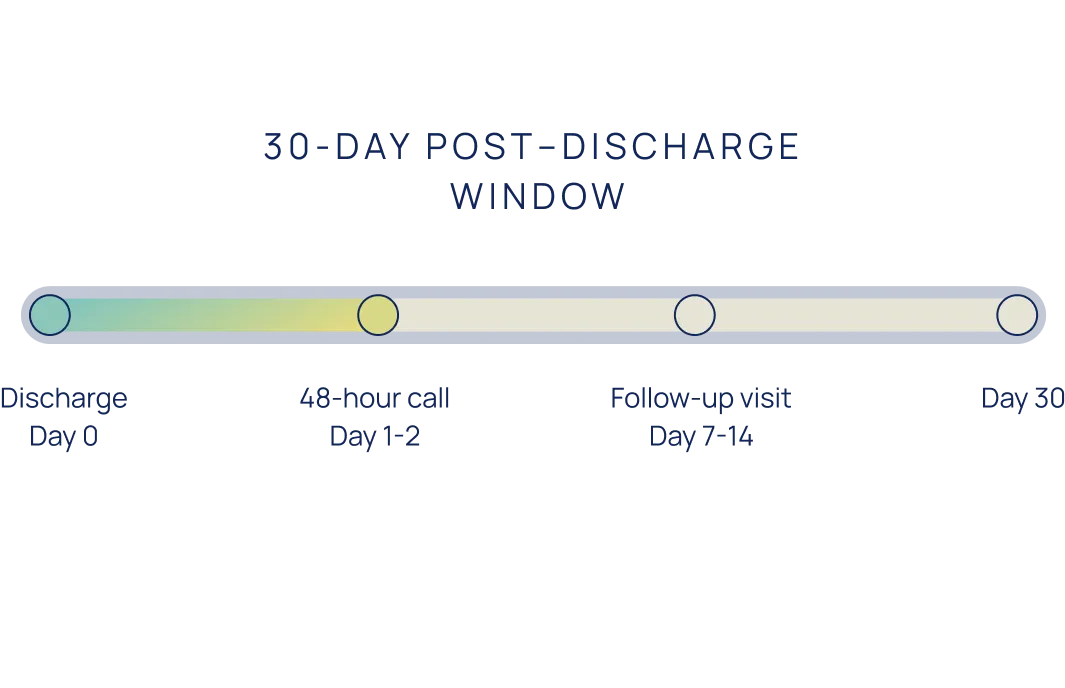
More than half of TCM-eligible Medicare discharges already get a qualifying follow-up visit within 14 days — yet most are never billed as Transitional Care Management. The clinical work was earned; the revenue was left uncaptured. CareAtlas closes the window.
.webp)
The post-discharge work that reduces readmissions.
CareAtlas handles the full Medicare TCM workflow — the 48-hour outreach, the medication reconciliation, the follow-up visit scheduling, and the 30-day transition period — end to end.
A live voice. Within two days. Every time.
CareAtlas navigators call every enrolled patient within 48 business hours of discharge. Introduce themselves. Confirm the patient made it home safely. Walk through the discharge instructions. Flag any red flags — worsening symptoms, missing medications, gaps in the post-discharge plan — for the clinician immediately.
.webp)
What they left the hospital with. What they're actually taking. Reconciled.
Hospital discharge medication lists rarely match what the patient brings home — duplicates, omissions, substitutions, and adherence gaps hide there. CareAtlas's med-rec touch reconciles the discharge list against the patient's current medications, the PCP's chart, and the pharmacy's records. Discrepancies get resolved before they become an adverse event.
.webp)
The post-discharge visit happens — because we scheduled it.
CareAtlas coordinates the post-discharge follow-up appointment with the PCP inside Medicare's required window (7 or 14 days, depending on acuity). Transportation barriers surfaced on the first call. Scheduling done against the PCP's actual availability. A confirmation touch the day before. Show rates that actually hold.
.webp)
99495 and 99496 — captured structurally.
TCM reimbursement requires specific timing (outreach in 2 business days; face-to-face follow-up visit in 7 or 14 days) and specific documentation. HealthQuilt captures every element as it happens. Claim assembly is a click. Clean claims. Fewer denials.
.webp)
Two codes. One 30-day window. Specific requirements.
TCM reimburses the post-discharge care transition across a 30-day period, anchored by a face-to-face follow-up visit. Two codes. CareAtlas captures the timing and the documentation structurally, so the window is met and the claim is clean.
$220
- Contact within 2 business days of discharge.
- Face-to-face visit within 14 days.
- Medical decision-making of at least moderate complexity.
$298
- Contact within 2 business days of discharge.
- Face-to-face visit within 7 days
- Medical decision-making of high complexity
Timing, strictly.
TCM's reimbursement depends on two windows: the 2-business-day outreach and the 7-or-14-day face-to-face visit. Miss either and the episode is unbillable — even if the clinical work was done. CareAtlas's operating model is built to hit both windows on every discharge.
Where the capture
gap lives.
TCM billing has grown, but the majority of eligible Medicare discharges still go uncaptured — as recently as 2019, only about 18% of eligible discharges were billed for TCM 18% · HHS ASPE/NORC, Analysis of 2019 Medicare FFS Claims for CCM and TCM Services (2022). And more than half (52%) of the unbilled discharges already had a qualifying office visit inside the 14-day window 52% · Bindman AB, Cox DF, JAMA Internal Medicine 2018;178(9):1165–1171. The clinical work was done. What's missing is the post-discharge outreach call and the structured documentation that ties it to the visit. That's what CareAtlas captures.
2026 Medicare national averages. Varies by locality and payer. Not a guarantee of revenue.
Every hospital discharge, every SNF discharge, every observation-to-outpatient transition. Coordinated.
TCM is for the 30 days after an acute-care discharge — the window in which the vast majority of 30-day readmissions happen, and the window in which they are most preventable. CareAtlas runs TCM for hospitals (discharges into their own ambulatory service lines or into affiliated PCPs), for physician practices (receiving discharge-to-home referrals), for community health centers and FQHCs, and for value-based organizations whose attributed lives include recent discharges.
Hospital TCM reduces readmissions directly; Medicare readmissions cost ~$17.5 billion annually, with approximately $12 billion of that potentially preventable. TCM is one of the highest-ROI interventions available — when the operational model can hold the 2-day and 7/14-day windows reliably.
.webp)
The operating model that hits the 2-day window every time.
TCM's reimbursement and clinical value both depend on hitting the 2-business-day outreach window. Most programs miss it — because the outreach competes with in-office clinical workload. CareAtlas hits it because the outreach is a dedicated, separately staffed workflow.
.webp)
The discharge ping lands with us.
Discharge notifications reach CareAtlas through the referral channel the partner already uses — CarePort, direct EHR integration, fax, or CSV. The patient enters the TCM workflow within minutes, not days.
.webp)
A dedicated navigator. A dedicated window.
CareAtlas navigators operate with protected capacity to make the 48-hour call on every TCM enrollment. The call covers safety check-in, discharge-instruction review, medication reconciliation triage, and follow-up scheduling. Clinical escalations route in real time to a clinical navigator or the PCP.
.webp)
The PCP visit gets on the calendar. The summary lands in the chart.
CareAtlas schedules the face-to-face follow-up inside the required window, surfaces transportation or caregiver barriers, and sends a structured TCM summary into the PCP's EHR before the visit. The physician walks into the room already briefed.
The 30 days don't end in a cliff.
TCM's 30-day window hands off seamlessly into ongoing CareAtlas programs — so patients don't get dropped the day the TCM episode closes.
.webp)
.webp)