
The platform that makes a small care team act like a big one.
HealthQuilt is the AI-assisted care coordination software behind every CareAtlas program. It documents the visit you didn't have time to chart. It surfaces the patient you didn't have time to call. It prepares your navigators for the conversation before they dial. Built for the team you already have.
Three jobs. One platform. Every patient accounted for.
HealthQuilt does the coordination work that buries most care teams — the charting, the tracking, the month-end scramble — so the time your patients get is human time. It's how a small care team acts like a big one.
01
AI prepares the human
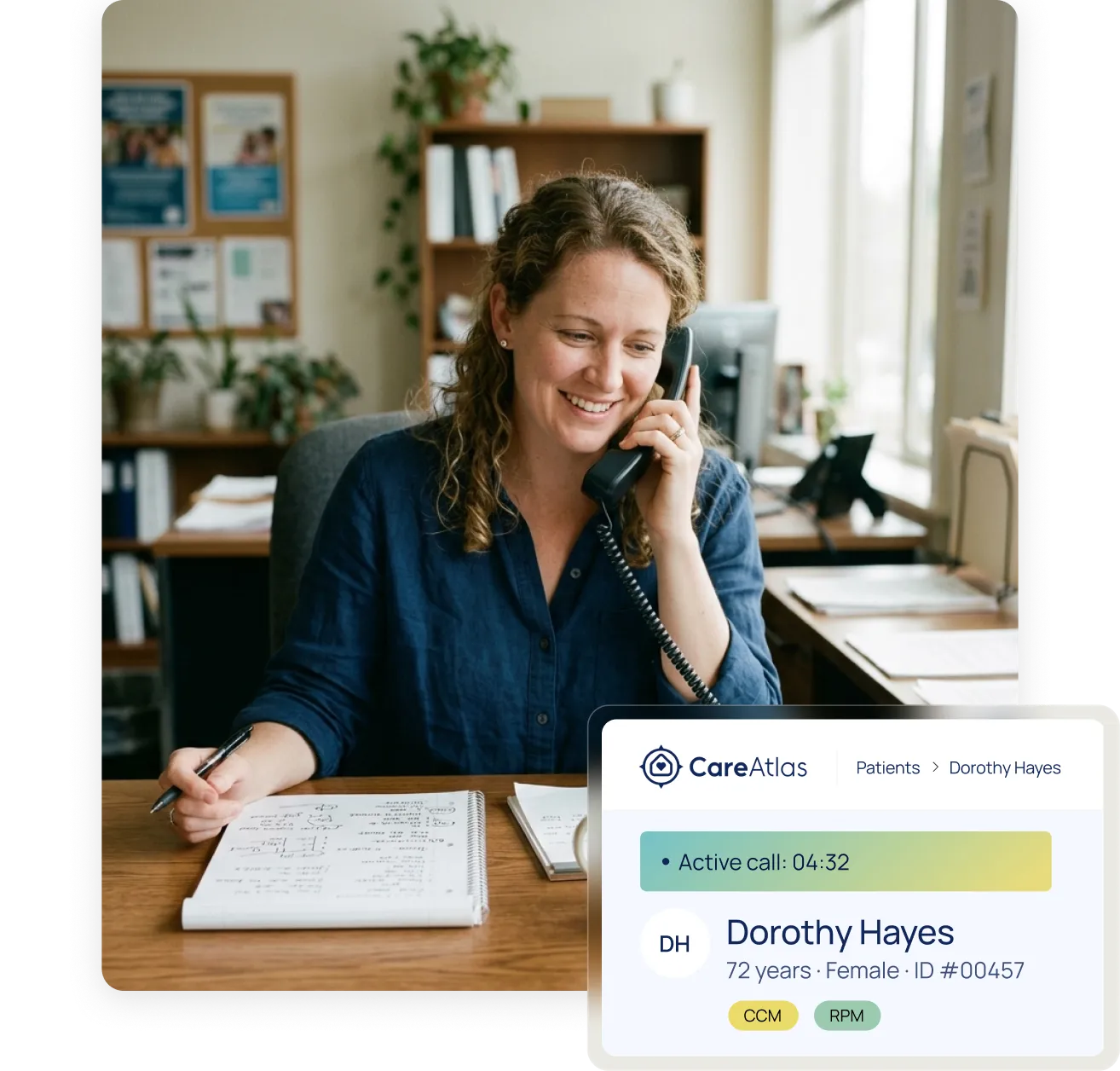
Before every call, the navigator opens a 90-second brief — what changed since the last touch, what to ask about today, what the clinician flagged — alongside a three-patient "top of the day" list ranked by clinical risk and days since last touch. Not a queue of 80. The patients who fall through the cracks in most programs are the ones who stay visible in this one.
02
The human leads the call
A named navigator has the conversation. HealthQuilt listens, drafts the note — SOAP, SBAR, care-plan revision, TCM medication reconciliation — and suggests the next best action. A clinician reviews and signs; most drafts are signed without edits. Not a chatbot. Not an app. A person.
03
Billing and compliance without a billing specialist
Every qualifying minute, every required CCM / TCM / APCM element is logged in a structured format as the work happens — so month-end is a report, not a reconciliation, and the program stays audit-ready. A 200-patient APCM panel is roughly $129,600 a year in recurring Medicare revenue.*
*Based on 200 patients at the Level-2 APCM rate (~$54 PMPM, G0557) over 12 months. Actual reimbursement varies by tier, patient complexity, and the CMS Physician Fee Schedule. Not a guarantee of revenue.
Five layers. One coordinated system of record.
HealthQuilt is not a chat interface on top of an EHR. It is a purpose-built platform for care management — data, orchestration, documentation, integrations, and compliance in a single system that was designed for this work, not retrofitted to it.
Every patient, fully assembled.
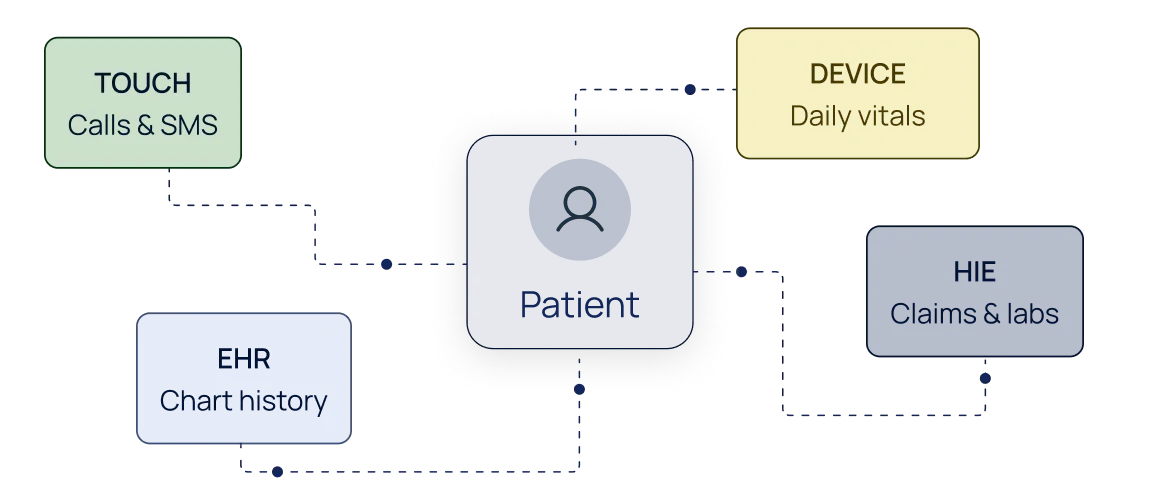
HealthQuilt pulls from your EHR, from HIE and national record-exchange networks, from device streams, and from every navigator touch — then assembles a unified longitudinal record. Medication history. Diagnoses and problem lists. Vitals trends over months, not snapshots. SDOH context captured by a human who asked. The touch-level context no EHR captures is what makes the coordination work.
.webp)
AI that prepares the human, then gets out of the way.
HealthQuilt runs purpose-specific AI agents behind the scenes — a pre-call briefing agent, a documentation agent, an RPM triage agent, a care-gap agent, a claim-narrative agent. Each agent does one thing well. None of them talk to the patient. All of them make the human on the call better-prepared than they could be alone.
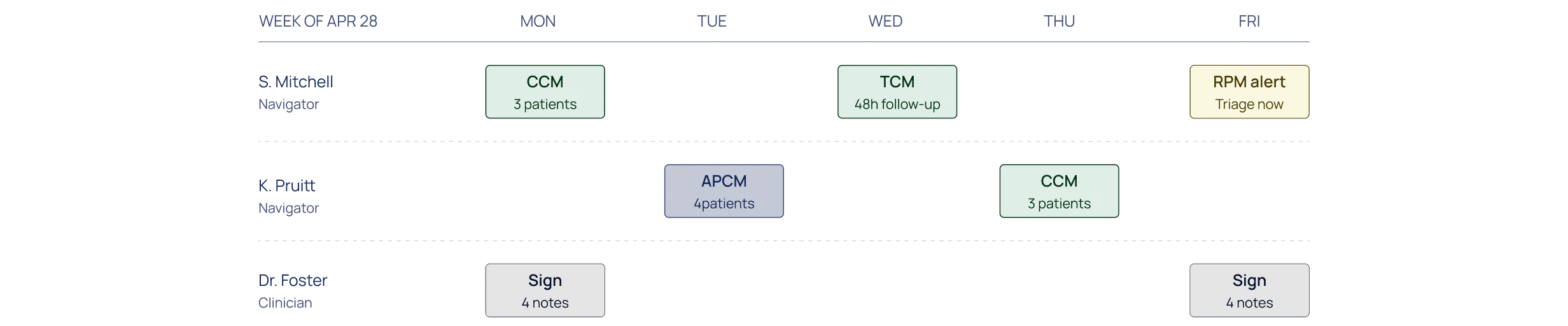
The right touch, by the right person, at the right time
HealthQuilt orchestrates thousands of touches across hundreds of patients — assigning each one to the navigator or clinician whose license, certification, and workload match. Monthly CCM outreach. 48-hour TCM follow-up. Triage of a high-BP RPM reading. An APCM care-plan refresh. The platform routes it — the human delivers it.
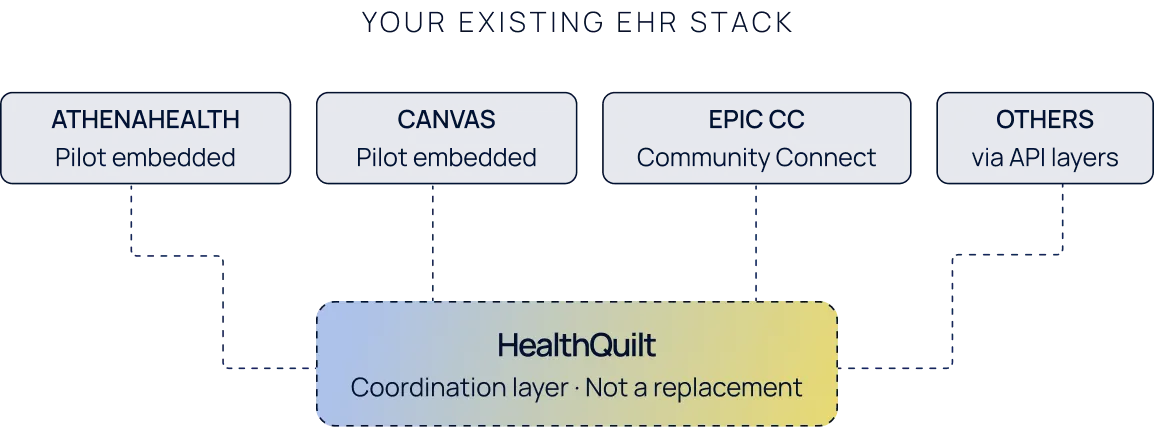
Lives inside the workflow the physician already has.
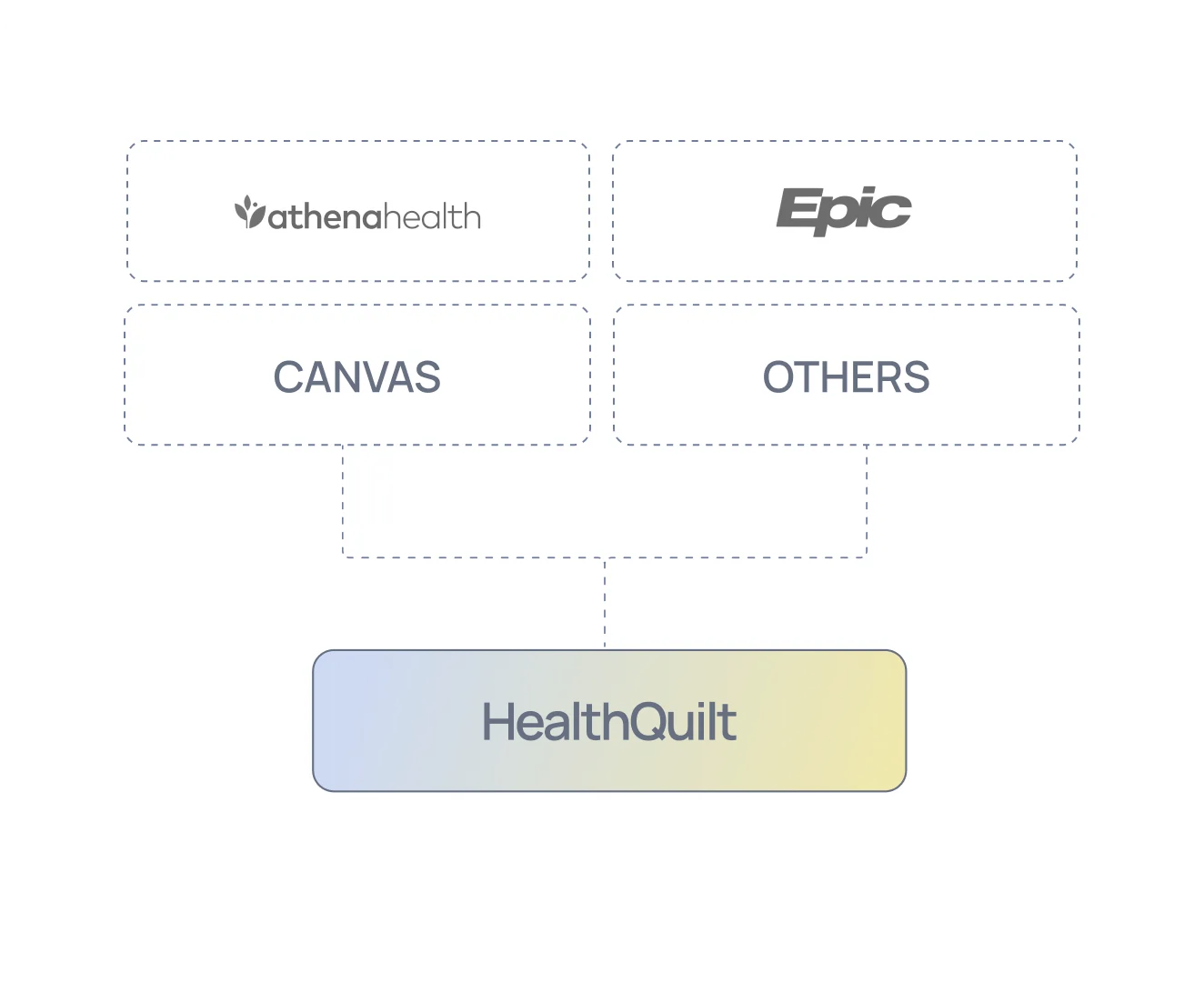
HealthQuilt connects through HL7 FHIR — the interoperability standard every certified EHR is federally required to expose. It reads the patient's chart and, using SMART on FHIR, can launch inside the EHR and return structured summaries to it. Live today with athenahealth; standards-based connectivity with Epic, Oracle Health, Canvas, Meditech, and the rest. Physicians see CareAtlas insights inside their existing workflow — no separate login, no new IT project
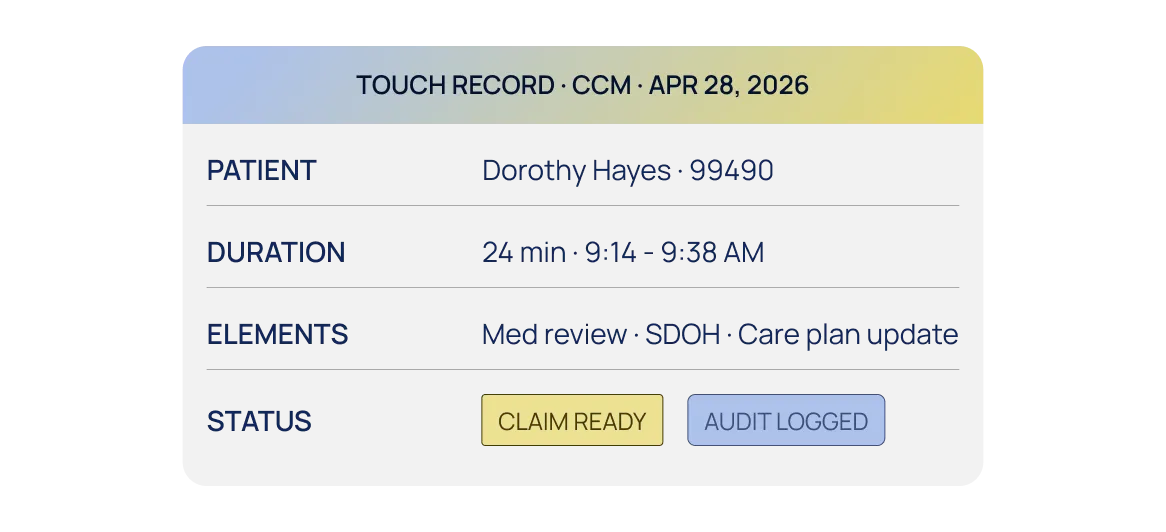
Every required element, captured as it happens
Time tracking by CPT code. Required care-plan elements for CCM. Medication reconciliation timestamps for TCM. Risk-tier attribution for APCM. Consent capture. Audit logs. Everything Medicare asks for at claim time is captured structurally during the work — not reconstructed afterward. Clean claims. Fewer denials. No paper-chase.
Built for the hundred small things that make care management work.
Every feature in HealthQuilt exists because a navigator, clinician, or billing lead said "the thing that breaks this program is…" — and we built the specific fix. No feature theater. No dashboards nobody opens.

Pre-call briefing
Navigator opens a patient and sees a 90-second summary of what changed since the last touch, what to ask about today, and what the clinician flagged.

AI-drafted clinical
documentation
SOAP notes, SBAR updates, TCM med-rec drafts, APCM care-plan refreshes. Drafted, not written. Reviewed and signed by the licensed clinician.

RPM triage
Incoming device readings are triaged continuously. Transient single-value outliers get acknowledged — sustained deterioration gets escalated to a clinical navigator in real time.

Care-gap ranking
Every morning, every navigator sees their three-patient "top of the day" list — ranked by clinical risk and days-since-last-touch, not by alphabetical order.

Consent and eligibility
capture
Structured consent recording and Medicare eligibility checks at enrollment — no paperwork backlog.

Longitudinal chart
One continuous record per patient across programs, care transitions, and years. No episode silos. No reconstruction.

Claim narrative assembly
Every billable service ships with a narrative sufficient for audit — generated from the touch record, not retyped at month-end.
Built to work inside the EHR you already run.
HealthQuilt is not a replacement system. It connects through your EHR's certified FHIR API — pulling chart data on ingest and returning structured clinical summaries — so your physicians see the CareAtlas work inside the workflow they already trust. Because FHIR is federally mandated across certified EHRs, it can connect to every major certified system through the same standard — live in production with athenahealth today, others scoped and validated per engagement. Where an EHR's write access is limited, we return documentation through secure document exchange.
Patient data handled the way a patient would want it handled.
HIPAA-compliant from the ground up. PHI is handled under business associate agreements with our partner organizations and sub-processors. Patient-record access is logged and auditable. Every care team member — human or AI agent — operates with the permissions their license, certification, and role allow.
.svg)
HIPAA Security Rule compliance
Encryption in transit and at rest, access logging, minimum-necessary access controls, and formal breach response procedures.
.svg)
Business Associate Agreements
Business associate agreements govern how partner organizations, integration vendors, and sub-processors handle PHI.
.svg)
Role-based access control
Navigators, clinicians, billing staff, and partner users each see only what their role and license require. AI agents operate under the same permission model — not a bypass.
.svg)
Audit trail
Every chart access, every touch, every AI-generated draft, and every clinician override is logged and attributable.

SOC 2
Built to SOC 2 control standards; formal certification is on our roadmap. Security documentation and current compliance posture are available during diligence, under NDA.
.svg)
Affiliated professional corporation
For hospital partnerships, CareAtlas serves as provider of record through a corporate-practice-of-medicine compliant professional corporation. Legal structure and state licensure posture available during diligence.
One platform. Four Medicare programs.
HealthQuilt is the operating system behind every CareAtlas program. Same platform. Same team. Four distinct revenue and clinical models — run end-to-end.
Remote Patient Monitoring
RPM: Daily visibility into patient health
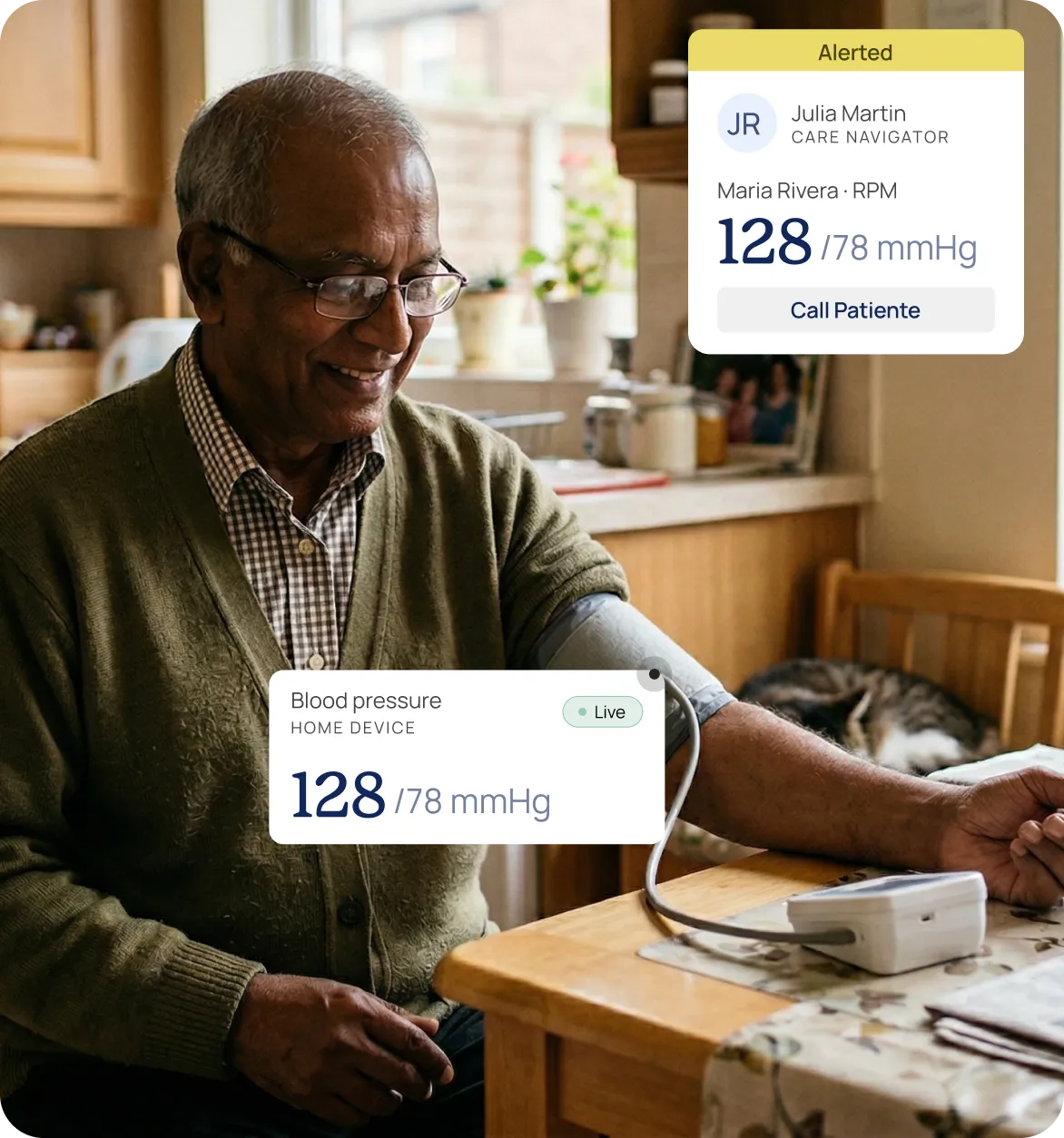
Cellular-connected devices ship directly to patients — blood pressure cuffs, glucose monitors, pulse oximeters, scales. No WiFi. No smartphone. No patient app. Daily readings are monitored by dedicated care navigators with AI-assisted alerts that catch deterioration before it becomes an ER visit.
Chronic Care Management
CCM: Consistent care between appointments
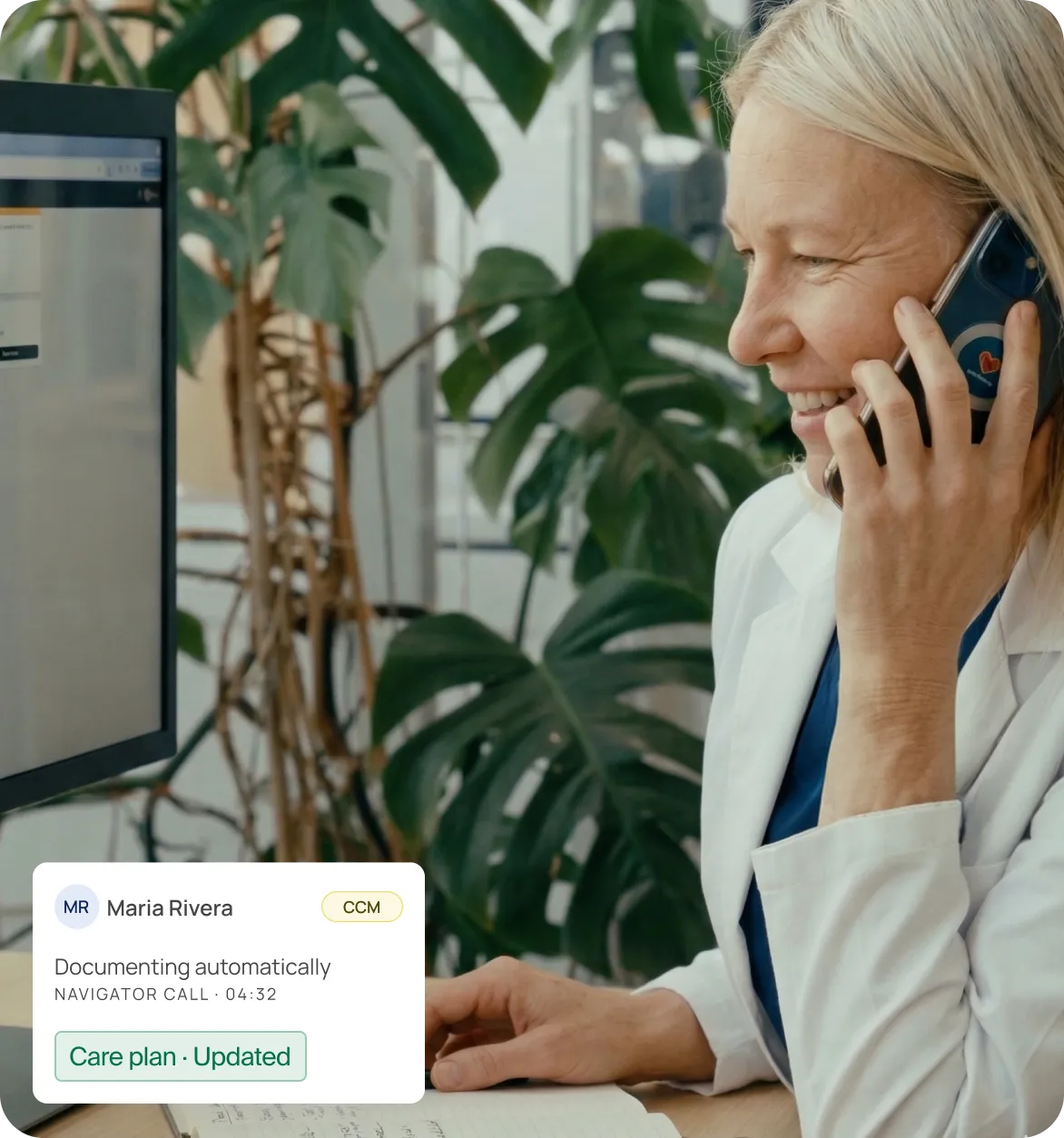
Monthly navigator check-ins, personalized care plans, medication management, and social determinant screening — all documented and billed under 99490/99491. Only about 18% of eligible Medicare discharges receive a TCM bill, even though roughly 52% of unbilled eligible discharges already had a qualifying visit within 14 days. CareAtlas helps close that gap.
Transitional Care Management
TCM: The critical 30 days after discharge
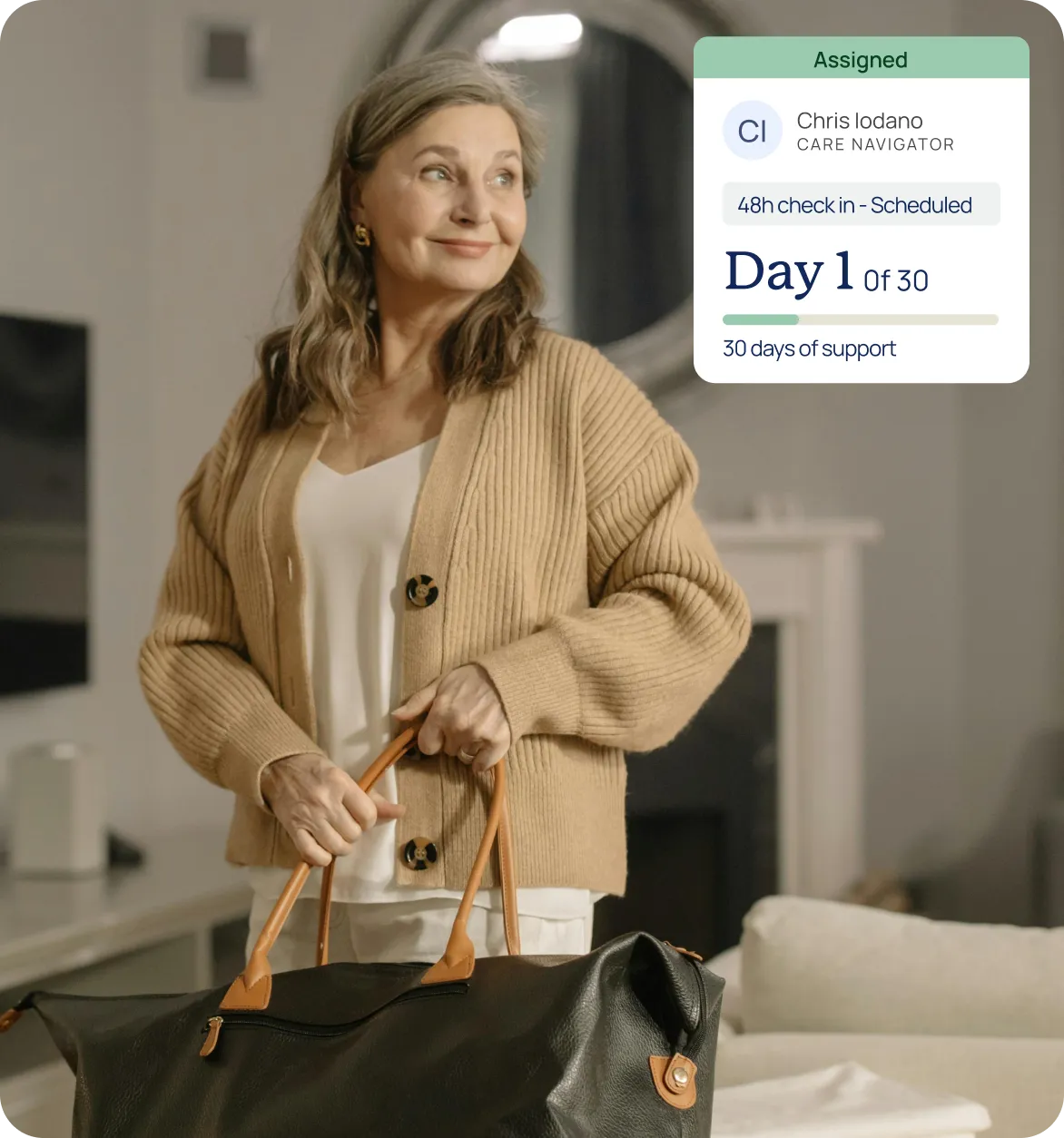
Navigator outreach within 48 hours of discharge. Medication reconciliation. Follow-up scheduling. 30 days of transition support during the window when patients are most vulnerable — and when the vast majority of billable TCM episodes go uncaptured. Only about 18% of eligible Medicare discharges are billed for TCM (HHS ASPE/NORC, 2019 claims), and among those unbilled, over half already had a qualifying office visit within 14 days — revenue left on the table.
Advanced Primary Care Management
APCM: The newest Medicare revenue pathway
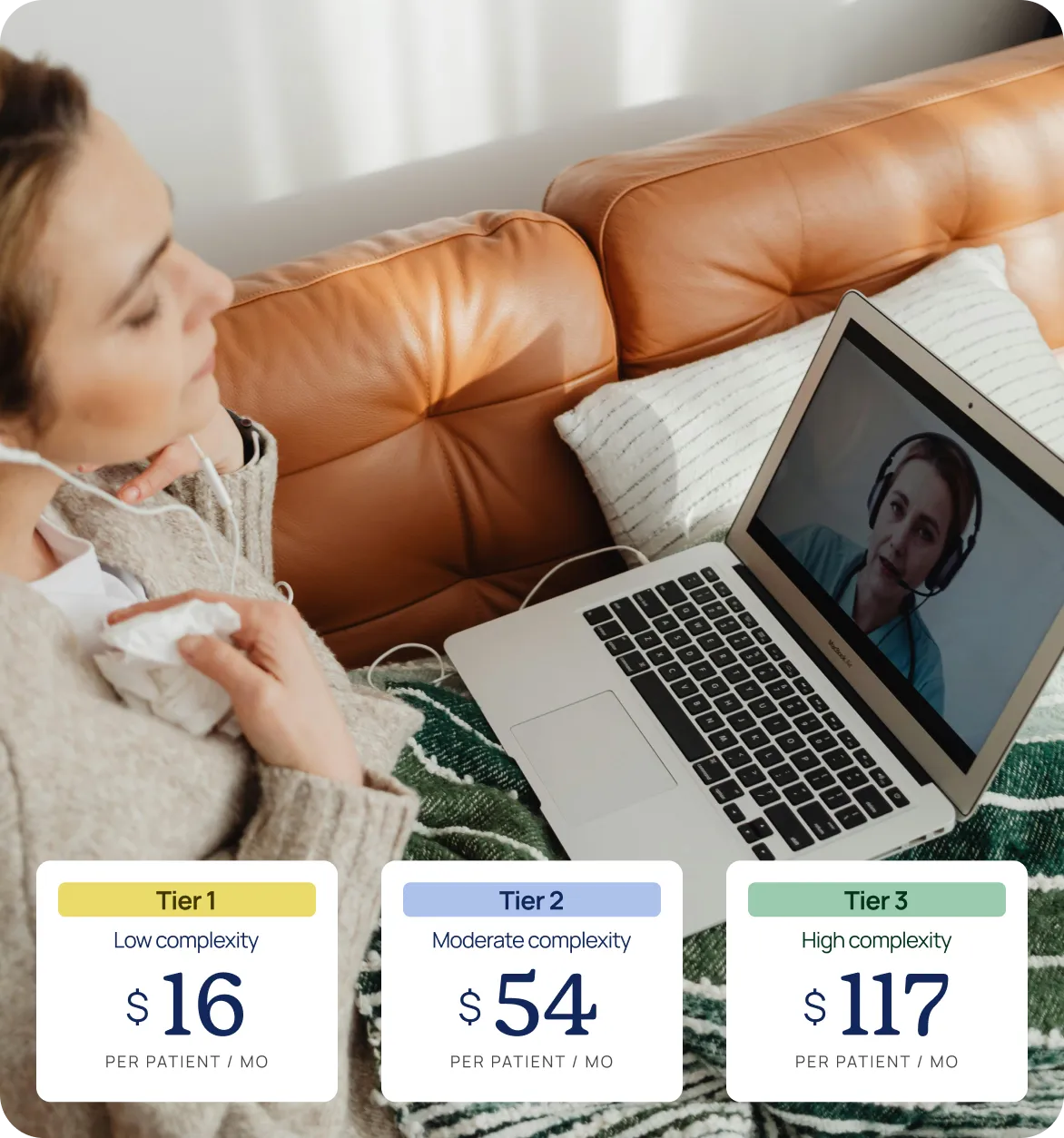
APCM reimburses across three risk-stratified tiers — $16/mo (Level 1), $54/mo (Level 2), and $117/mo (Level 3) — with no time-tracking requirements. For a panel of 200 patients at Level 2, that's ~$129K/year in recurring revenue, billable alongside RPM.