
Consistent care between appointments. Capture every month.
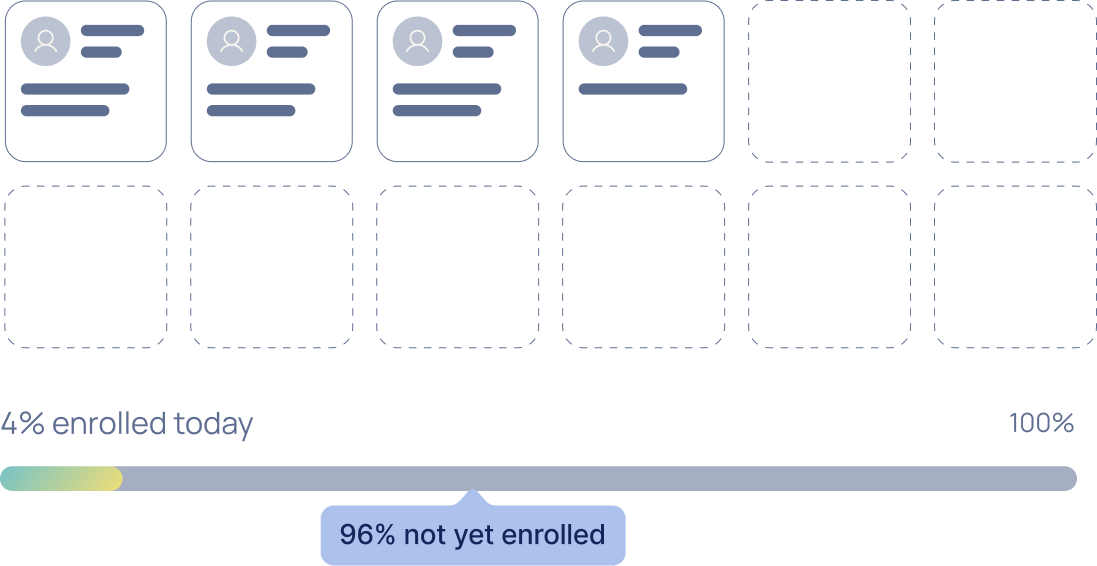
Only 4% of eligible Medicare patients are enrolled in Chronic Care Management nationally — because running it well is hard. CareAtlas runs it. Your practice captures the reimbursement. Your patients get the monthly contact their conditions actually require.

Every element CMS asks for. Delivered
CareAtlas runs Chronic Care Management end-to-end — enrollment, monthly touches, care plan maintenance, medication coordination, SDOH screening, documentation, and billing. The qualifying work happens. The claim is clean.
Patients enrolled. Care plan in place
CareAtlas identifies eligible patients on your panel, obtains consent, and builds a personalized care plan before the first monthly touch. No enrollment project on your side. No stalled spreadsheets.

A real person.
A real relationship. Every month
Each patient gets a dedicated, named care navigator who calls them on cadence, asks the right questions, and logs what they learn. 4+ monthly touches on average. Not a scripted operator. Not a chatbot. A person who remembers your patients between calls.
.webp)
Meds. Barriers. Access. Captured
Every touch covers medication adherence and refills, and structured SDOH screening (transportation, food, housing, social support). Barriers that would have become an ER visit get identified — and acted on — a month earlier.
.webp)
Every qualifying minute, captured as it happens.
CCM's time-based billing requires structured capture of every eligible minute and every required element. HealthQuilt records them in real time. Month-end claims export cleanly into your existing RCM — or are billed by CareAtlas under our affiliated professional corporation, depending on the model you choose.
.webp)
The code stack — with two new codes for 2026.
RPM's 2026 code set expanded. CMS finalized two new codes that make RPM viable for patient populations the old thresholds excluded — patients who transmit data fewer than 16 days a month, and patients whose monthly clinical monitoring runs less than the original 20-minute threshold. CareAtlas captures every qualifying element; your practice bills — or CareAtlas bills on your behalf under a hospital partnership.
$66
- Foundation code for CCM
- 20 min of clinical staff time / month under physician supervision
- Covers monthly navigator touch, medication review, SDOH screening, care plan maintenance
- 2026 rate reflects ~10% increase from 2025
$50
- Add-on for patients exceeding base minutes
- No cap on add-on units per month
- Time captured as it happens — not reconstructed at month-end
- Eligibility documented structurally by CareAtlas
$144
- For patients requiring moderate-to-high MDM
- Typically 60+ minutes of coordination per month
- 99487 reimburses ~$144 for first 60 min · 99489 adds each additional 30 min
- HealthQuilt surfaces qualifying patients automatically
$89
- Physician or QHP performs coordination personally
- 30 minutes / month minimum
- Cannot be billed same month as 99490
- Captured alongside navigator CCM — nothing overlaps, nothing gets missed
Rates reflect 2026 national averages under the CY2026 Medicare Physician Fee Schedule (rounded). Locality-specific rates apply.
Patients with two or more chronic conditions — and the practices trying to keep them healthy between visits.
CCM is for the patients whose conditions are routinely well-managed at the moment of a quarterly visit and routinely drifting by week six. Hypertension and diabetes. COPD and heart failure. Kidney disease and depression. Two or more conditions that together account for most of the cost — and most of the avoidable readmissions — in a Medicare panel.
CareAtlas delivers CCM on behalf of primary care practices, community health centers and FQHCs, health systems with attributed lives, and value-based organizations that need a coordination layer across their contracted providers. CCM covers the patients whose monthly coordination load clinically exceeds what APCM can absorb. CCM is an alternative to APCM for those patients (bill one or the other in a month), not stacked.
.webp)
One platform. Real navigators. Monthly cadence that actually holds.
The reason most CCM programs underperform is not the code set — it's that the monthly cadence collapses under workload. CareAtlas holds the cadence by doing the coordination work outside your staff's queue.
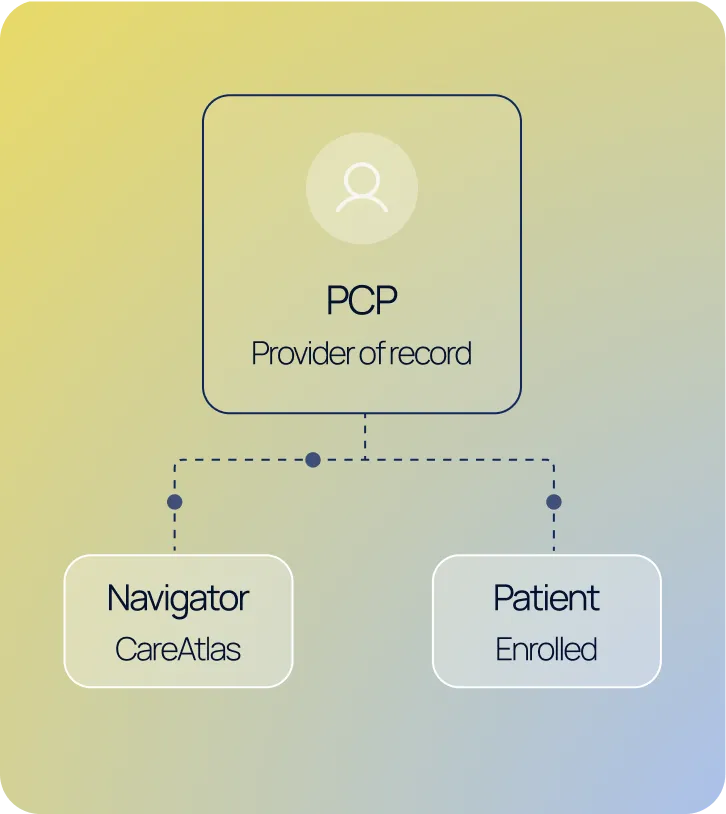
Your PCP. Our navigators. One patient, coordinated
CareAtlas identifies eligible patients, obtains consent (including the required annual consent language), and builds the initial care plan. The physician signs and remains provider of record. No staffing addition on your side.
.webp)
20+ minutes of qualifying care. Captured every month.
Each navigator works a panel they know. Monthly touches cover medication, symptoms, barriers, care-plan updates. Every minute lands in the structured CCM time log — 99490, 99439, and 99487 / 99489 where complex CCM applies.
.webp)
Clinical concerns flow back to the physician — inside their EHR.
When a touch surfaces something the PCP needs to see — worsening vitals, a new symptom, a medication conflict — CareAtlas pushes a structured clinical summary back into the EHR the physician already uses. No separate login. No separate inbox.
CCM rarely stands alone. Here's what runs with it.
Most CCM patients also qualify for remote monitoring or post-discharge support.
CareAtlas runs them as one coordinated program — no double-counting, no duplicate claims.
.webp)
.webp)
.webp)