
Care that feels like a real person called. Because one did.
No app to install. No login to remember. No broadband required. Every patient enrolled in a CareAtlas program gets a dedicated, named care navigator who calls them on cadence, learns their history, and builds a relationship over months and years — with licensed clinicians overseeing every navigator team. The devices ship to the door, set up in one button-press. The conversation happens on the phone that's already in the house.
.webp)
Three numbers that describe
what the patient experience actually is.
73%
of patients submit readings 8+ days a month
Adherence, translated. Patients don't "adhere" to a device. They pick up the cuff they trust because it's easy and because someone called to help them start. This is what that looks like in month two. And month six. And month twelve.
~85%
six-month
retention
Share of activated patients still enrolled at six months. The honesty metric — if the program felt like a call center to the patient, they'd tell us by leaving. They don't.
4+
monthly touches
per patient
Not "notifications." Calls. A named care navigator, month after month, asking about the things that matter — symptoms, meds, barriers, the daughter who moved to Austin.
.webp)
Built for the patient who's never used an app. Because most of them haven't.
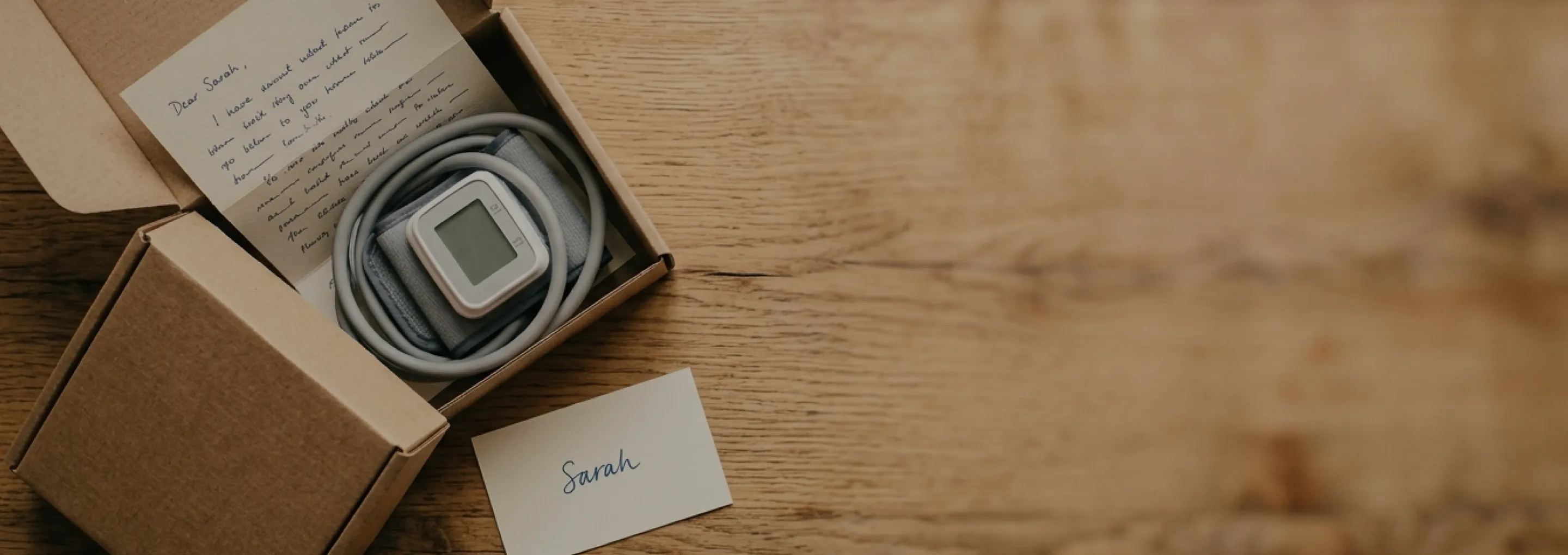
The patient side of a CareAtlas program is deliberately uninteresting. The device arrives in a box with a one-page guide. Cellular-connected — no WiFi, no smartphone, no pairing step, no QR code. Press one button — the reading flows. The first call doesn't come from a robot. It comes from a named navigator who introduces themselves, walks through the device on the phone, takes the first reading together, and schedules when to call next.
Nothing to download. Nothing to configure. Nothing to fail at. That's why 73% of enrolled patients are still using the device at month twelve. The tech did its job — it got out of the way.
Four programs. One relationship.
The patient never experiences "four programs." They experience one navigator who happens to know about their BP cuff, their monthly med review, their recent hospital stay, and their long-term care plan — because it's the same person doing the same job across all four.
Remote Patient Monitoring
RPM: Daily visibility into patient health
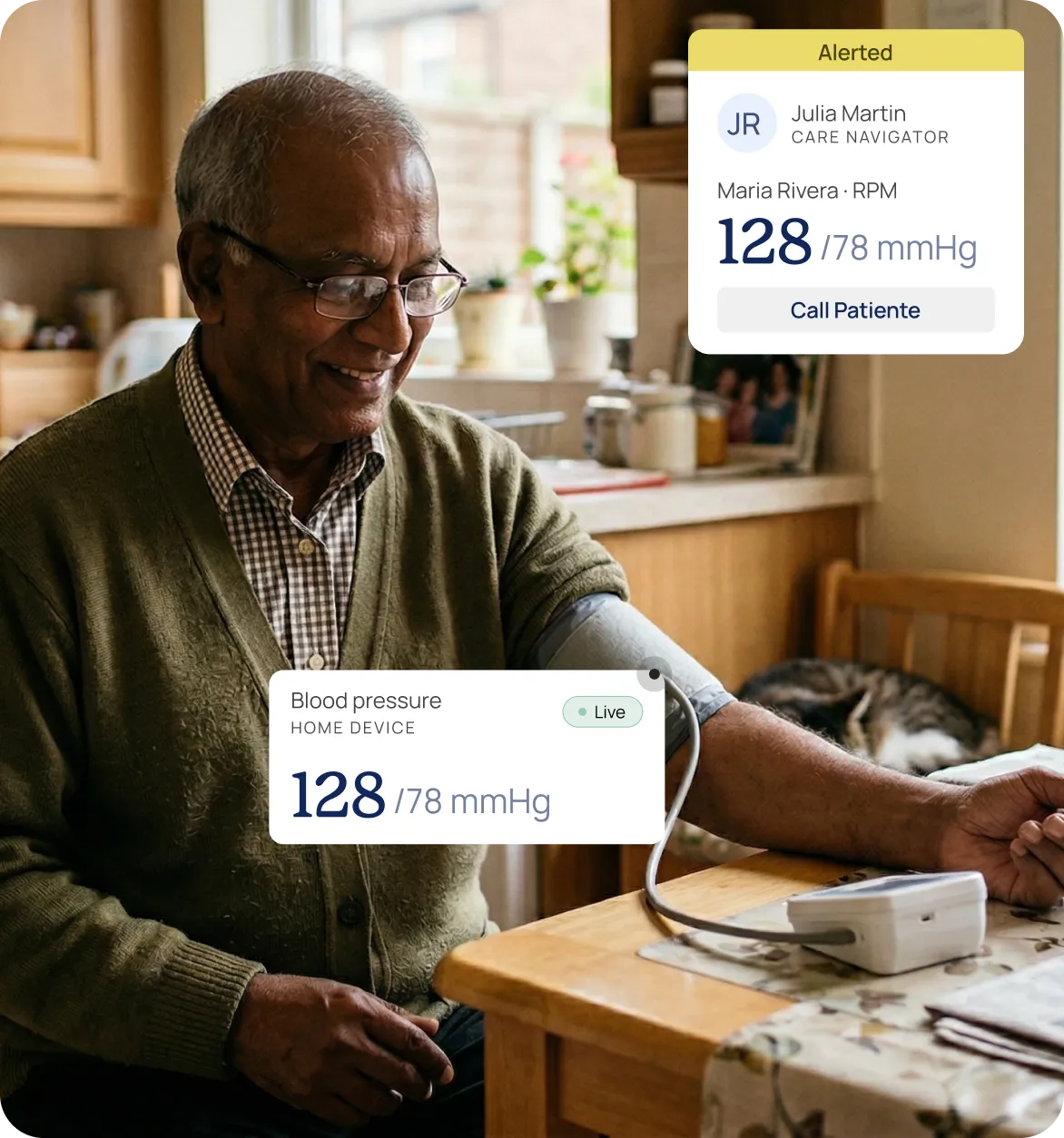
Cellular-connected devices ship directly to patients — blood pressure cuffs, glucose monitors, pulse oximeters, scales. No WiFi. No smartphone. No patient app. Daily readings are monitored by dedicated care navigators with AI-assisted alerts that catch deterioration before it becomes an ER visit.
Chronic Care Management
CCM: Consistent care between appointments
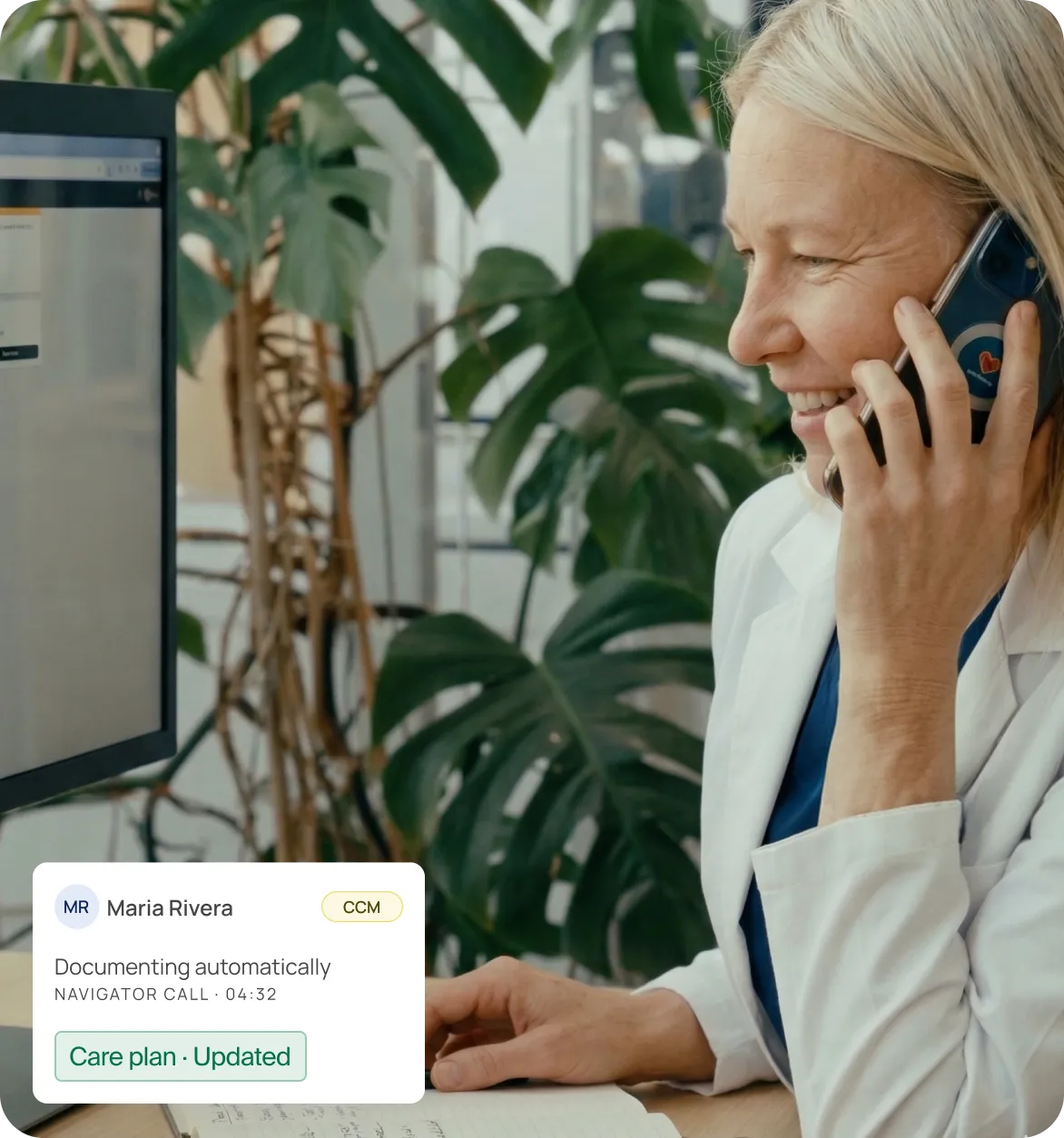
Monthly navigator check-ins, personalized care plans, medication management, and social determinant screening — all documented and billed under 99490/99491. Only about 18% of eligible Medicare discharges receive a TCM bill, even though roughly 52% of unbilled eligible discharges already had a qualifying visit within 14 days. CareAtlas helps close that gap.
Transitional Care Management
TCM: The critical 30 days after discharge
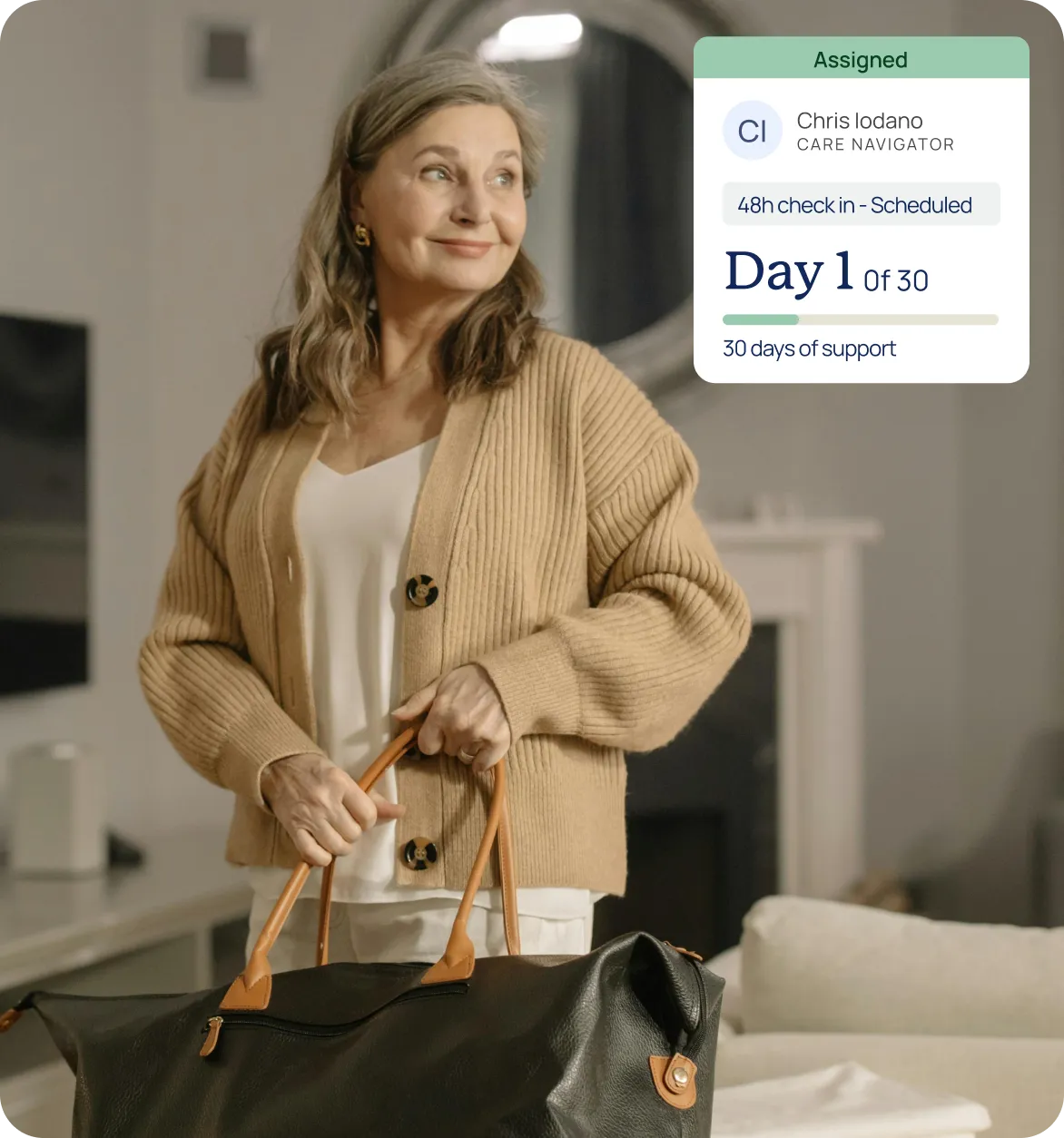
Navigator outreach within 48 hours of discharge. Medication reconciliation. Follow-up scheduling. 30 days of transition support during the window when patients are most vulnerable — and when the vast majority of billable TCM episodes go uncaptured. Only about 18% of eligible Medicare discharges are billed for TCM (HHS ASPE/NORC, 2019 claims), and among those unbilled, over half already had a qualifying office visit within 14 days — revenue left on the table.
Advanced Primary Care Management
APCM: The newest Medicare revenue pathway
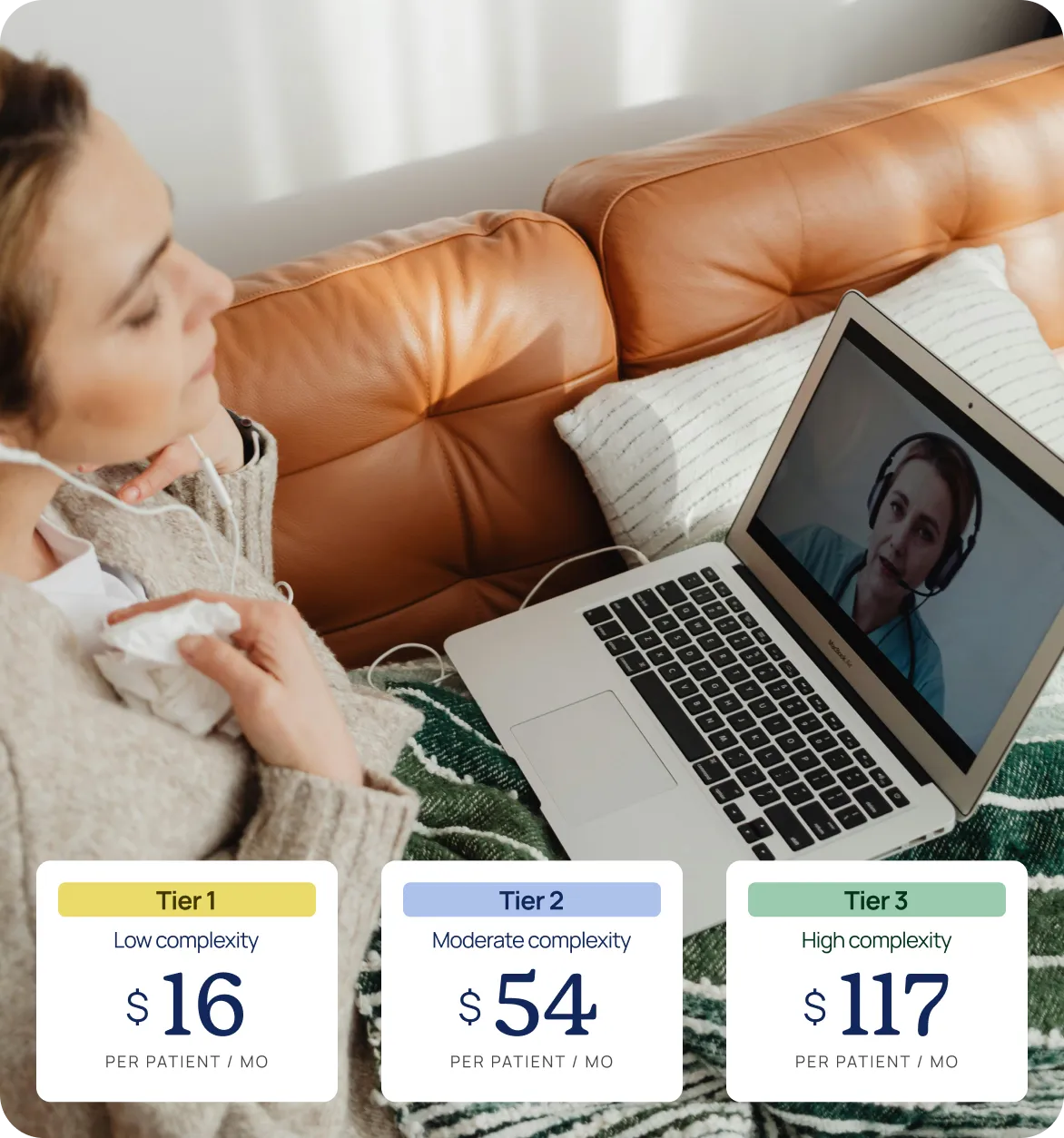
APCM reimburses across three risk-stratified tiers — $16/mo (Level 1), $54/mo (Level 2), and $117/mo (Level 3) — with no time-tracking requirements. For a panel of 200 patients at Level 2, that's ~$129K/year in recurring revenue, billable alongside RPM.
Designed for the patient who doesn't have broadband — and doesn't want to.
Our cohort is 89% age 65+, 38% COPD, 24% CHF. Many of them don't have home internet. Most of them don't own a smartphone.
A lot of them wouldn't open a patient portal if they did.
The program was designed for them — because the program that works for them works for everyone else. No WiFi required. No smartphone required. No app required. A named human on the line.
.webp)