
Daily visibility into your patients' health without an app, a login, or WiFi.
Most RPM programs fail on enrollment and engagement, not technology. CareAtlas runs a program where 73% of enrolled patients submit readings 8+ days per month. Cellular devices ship to the patient's door. A care navigator picks up the phone when a reading drifts. Your clinicians see the signal, not the noise.
Devices. Enrollment. Monitoring. Triage. Billing.
CareAtlas runs RPM end to end — the devices, the patient onboarding, the daily monitoring, the clinical triage, and the billing. Your clinicians see only what needs them.
Cellular-connected. Single button. No setup.
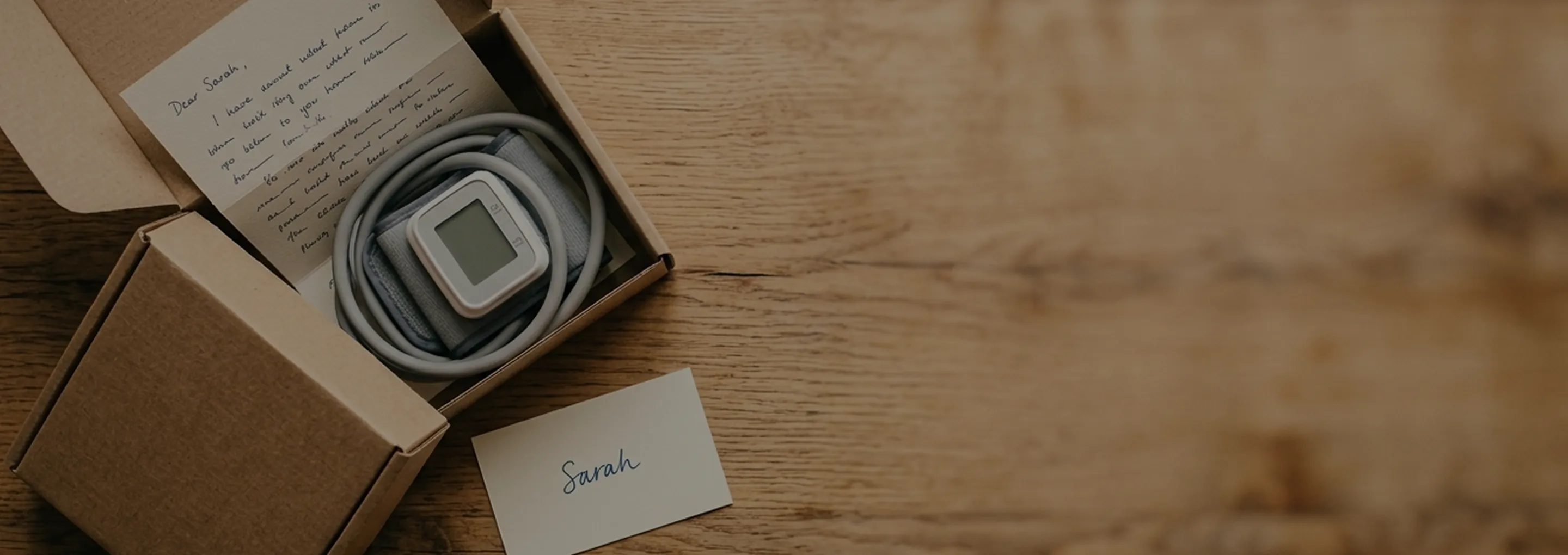
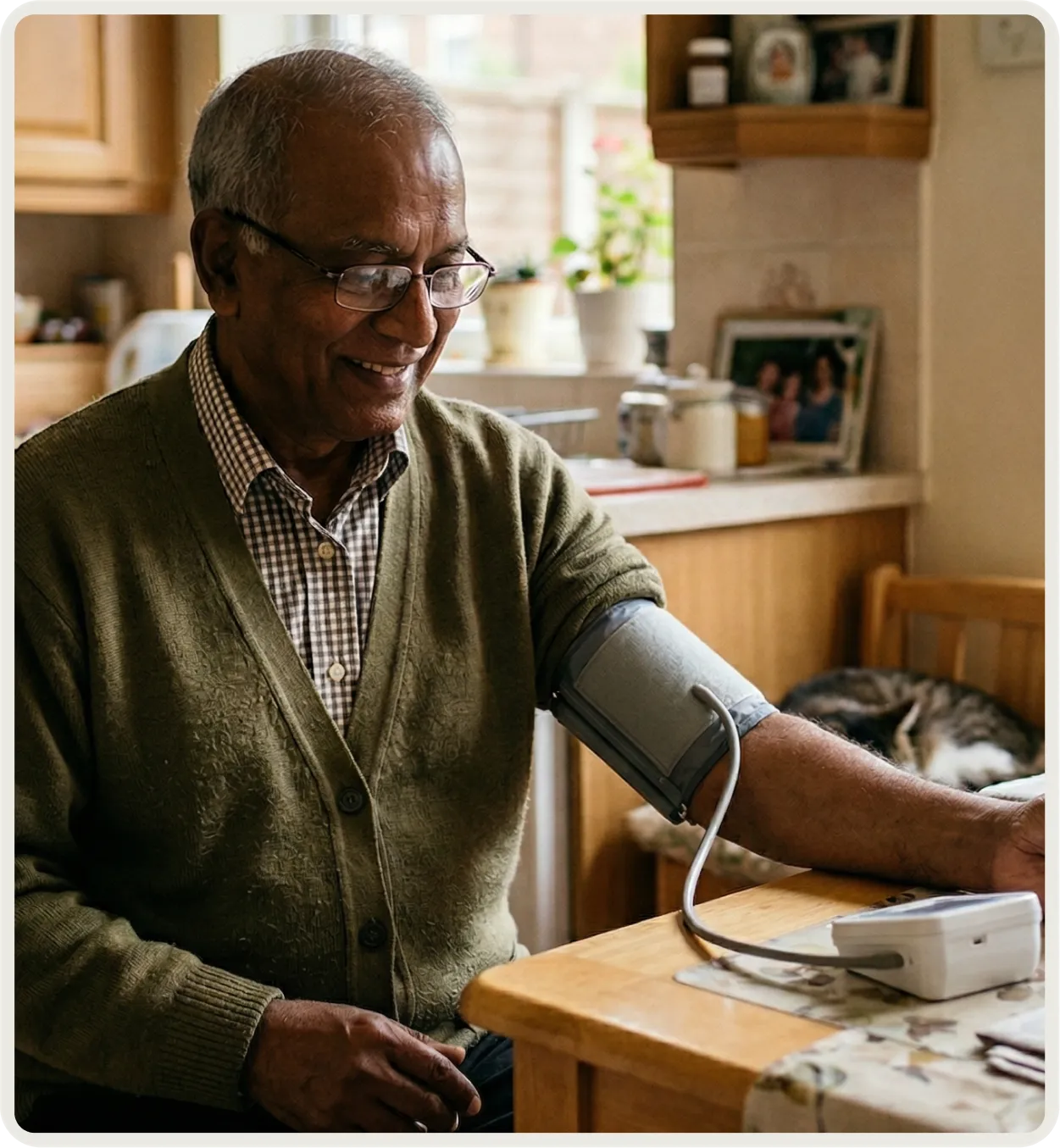
Blood pressure cuffs, glucose monitors, pulse oximeters, scales, and weight monitors. Pre-provisioned cellular — no WiFi, no smartphone, no Bluetooth pairing. Mailed directly to the patient's home with a one-page guide. Readings flow back automatically the first time the patient uses the device.
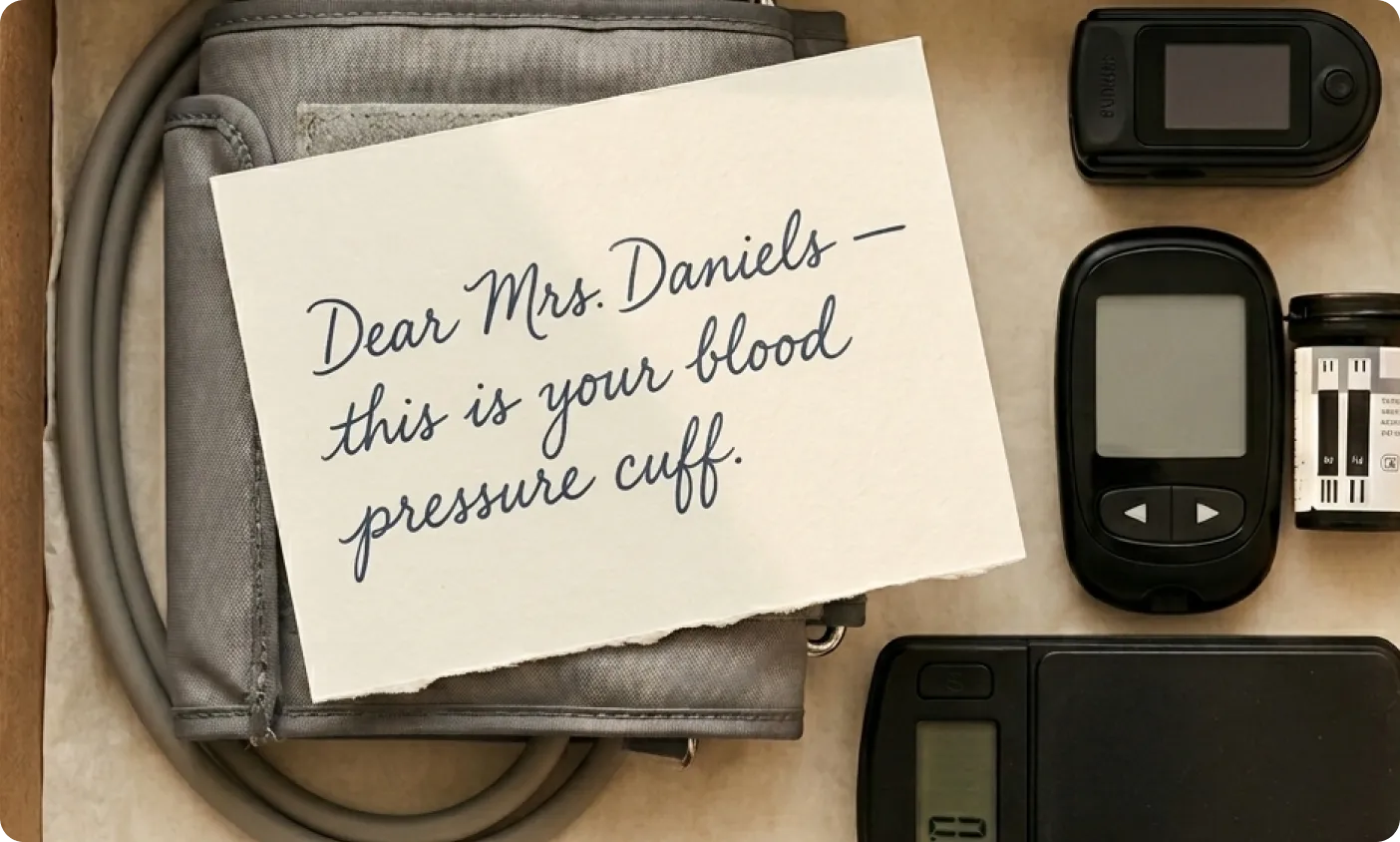
Enrollment isn't a signup flow. It's a phone call.
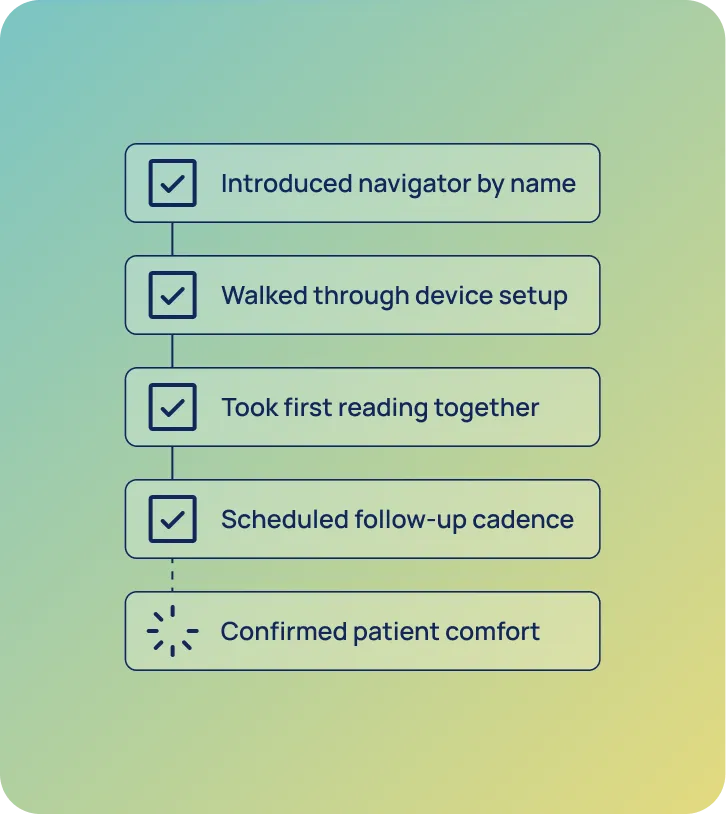
CareAtlas navigators call each enrolled patient personally — introducing themselves, walking through the device, scheduling the first month's cadence. That first conversation is why 73% of our patients are still submitting readings 8+ days a month months later. About 85% of activated patients are still with us at six months.
.webp)
The signal, separated from the noise.
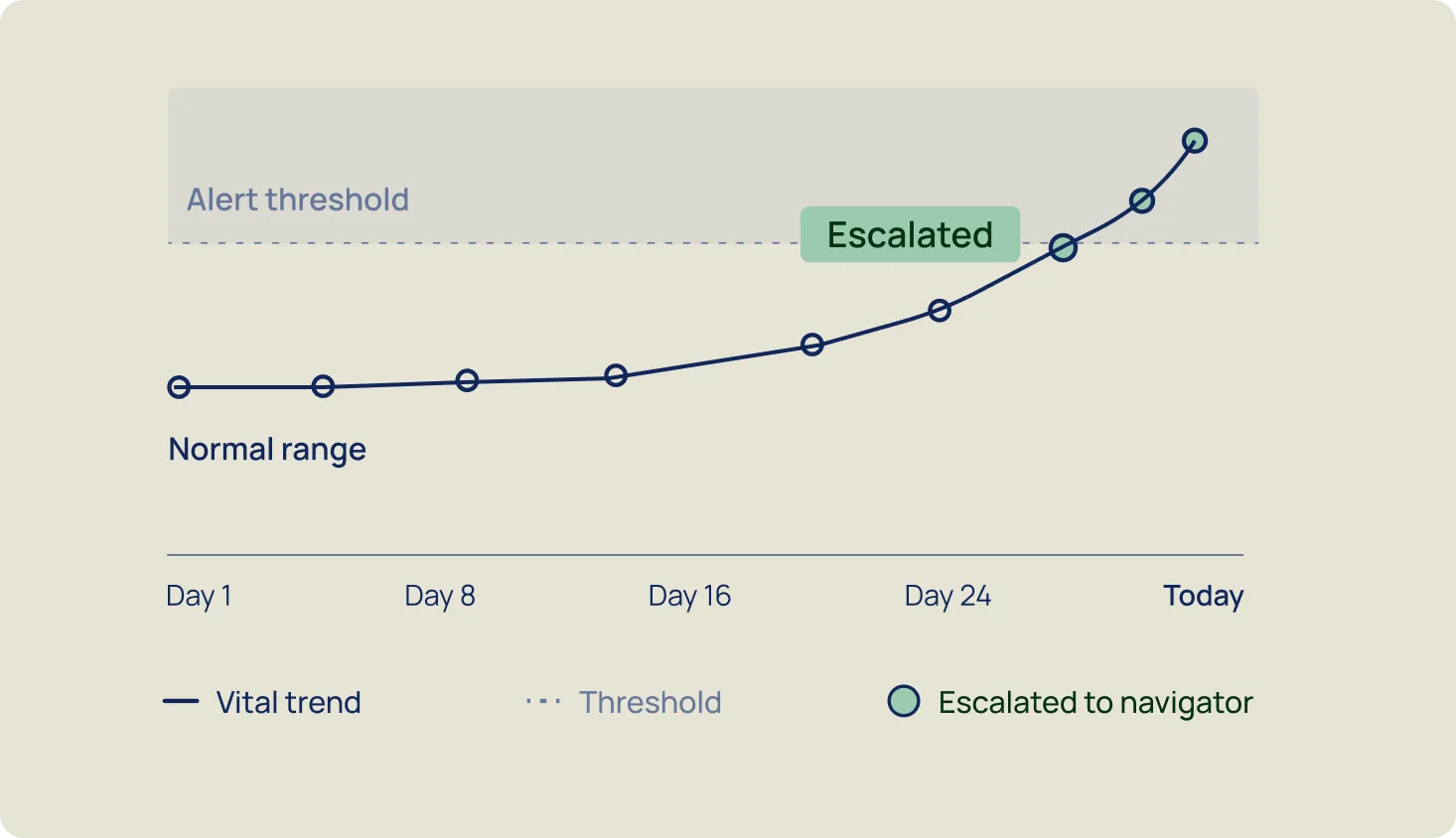
Every reading flows into HealthQuilt. AI-assisted triage acknowledges transient outliers, flags sustained deterioration, and routes clinically meaningful changes to a clinical navigator in real time. Your physicians are not scrolling through vitals dashboards. They see summaries, escalations, and the weekly digest that actually matters.
Every qualifying element, captured as it happens.
Device setup and education. Device supply and data transmission. Clinical staff monitoring time. Each threshold tracked structurally; each claim assembled cleanly. Hospitals bill through CareAtlas's affiliated professional corporation. Practices export claims into their existing RCM.
.webp)
The code stack — with two new codes for 2026.
RPM's 2026 code set expanded. CMS finalized two new codes that make RPM viable for patient populations the old thresholds excluded — patients who transmit data fewer than 16 days a month, and patients whose monthly clinical monitoring runs less than the original 20-minute threshold. CareAtlas captures every qualifying element. Your practice bills — or CareAtlas bills on your behalf under a hospital partnership.
$22
- One-time per device per patient
- Captured on the activation call
- Billable when setup is completed
$52
- Monthly device supply code
- Requires 16+ qualifying days of readings
- HealthQuilt tracks day count in real time
$52
- Same rate as 99454
- RPM now billable below 16-day threshold
- Patients previously unbillable now covered
$52
- First 20 minutes of clinical staff monitoring / month
- Reviewing readings + patient communication
- CareAtlas logs time structurally
$26
- Below 99457’s 20-minute threshold
- Requires one real-time interaction
- Stable panels now billable
$47
- Add-on beyond 99457
- HealthQuilt surfaces patients at 40, 60, 80min
- Nothing qualifying goes unbilled
Rates reflect 2026 national averages under the CY2026 Medicare Physician Fee Schedule (rounded). Locality-specific rates apply. CMS finalized a new valuation approach for RPM in 2026 based on OPPS Geometric Mean Cost data.
Patients whose conditions benefit from daily visibility — which, for most Medicare panels, is more patients than you'd think.
RPM is for patients with hypertension, diabetes, heart failure, COPD, and the other chronic conditions whose deterioration is gradual and silent between visits. Daily readings let a care navigator catch drift at week two instead of week eight. And because CareAtlas's cohort is 89% age 65+, 38% COPD, 24% CHF — a high-risk population — the outcome data isn't a best-case scenario. It's what the hardest cohort looks like when the program is run well.
CareAtlas delivers RPM for hospitals, community health centers, FQHCs, physician practices, and value-based organizations. RPM is commonly paired with APCM or CCM so the device data has clinical context, the clinical context has device data, and both programs bill concurrently. The new 2026 codes (99445 and 99470) extend RPM's reach to patients whose engagement profile didn't fit the old thresholds.
.webp)
The reason this program works where most don't.
Most RPM programs fail on enrollment and engagement, not technology. CareAtlas built the operating model around that fact — the devices are chosen so the patient cannot be blocked by setup, the first call is made so the patient cannot be left alone with a mystery box, and the triage is built so the clinical team never drowns in readings.
Built for the patient who has never used an app.
Cellular-connected. Single button. Large display. Factory-paired. Works out of the box. If the device in the box is the thing that ends the program before it starts, pick a different device.
A live human makes the first call.
Every enrolled patient gets an activation call from a named care navigator — walking through the device, taking the first reading together, and scheduling the follow-up cadence. This one call is the reason adherence holds at 73% at month two, month six, month twelve.
.webp)
Signal in. Noise out. Escalation owned.
HealthQuilt continuously triages incoming readings. Transient single-value outliers are acknowledged and logged. Sustained deterioration and critical values escalate to a clinical navigator in real time. Clinically equivocal situations surface to a clinician for judgment. Your physicians see the escalations, not the stream.
RPM is strongest when it's not alone.
RPM's device data becomes clinically useful when a care navigator is using it to inform a monthly touch. These three programs run alongside RPM to do exactly that.
.webp)
.webp)
.webp)