

A clearer handoff from discharge to ongoing care.
Work with CareAtlas to define how patient outreach, follow-up coordination and clinical escalation fit around the care your organization already provides.

The work does not end when someone goes home.
After discharge or a change in care setting, patients and families may be balancing medications, follow-up appointments, new instructions, and practical needs at the same time. Care teams need a reliable way to extend support without creating an unclear handoff or another disconnected process.
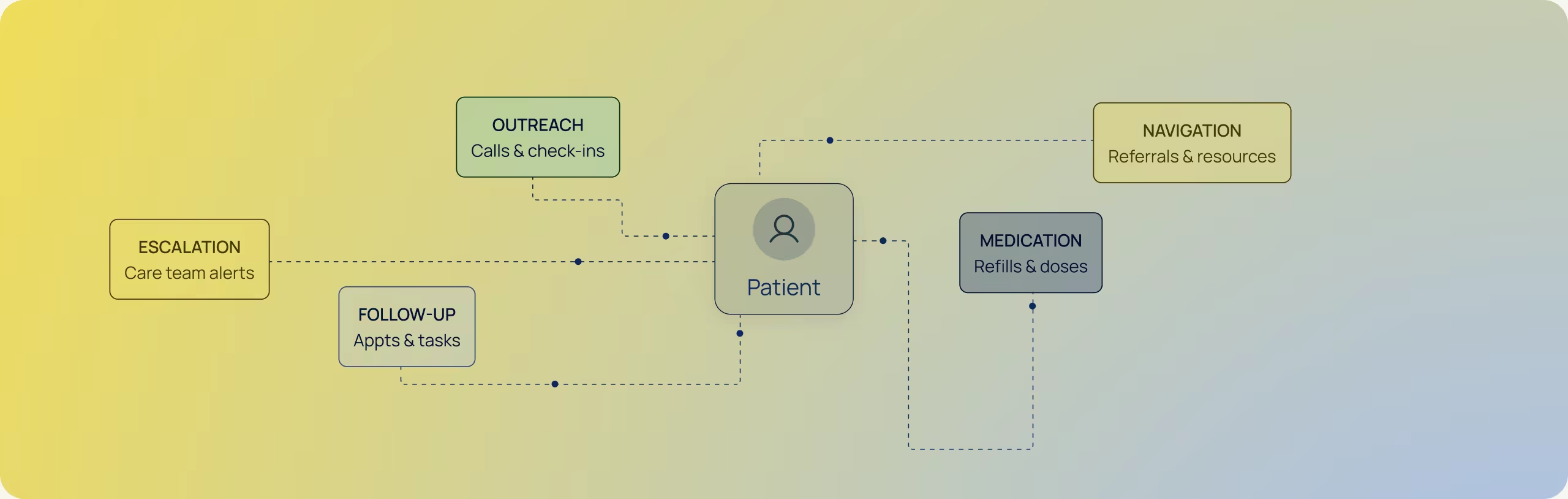
CareAtlas can work with your organization to define how patient and family outreach, follow-up, medication support, practical navigation, and escalation could fit around the work your team already does.
Where a partnership may fit
We begin with the transition your team is trying to improve, then determine whether a CareAtlas partnership may fit.
Hospital discharge and care-management teams
Extend support beyond discharge
Explore follow-up support for patients and families after discharge, with clear expectations for referral review, outreach and communication back to your team.
Home-health and post-acute teams
Create a clearer shared handoff
Explore a coordinated handoff between episodes or settings of care. Define how CareAtlas support would complement your services and when responsibility moves to another clinician or team.

Other clinical organizations
Start with the population and workflow.
Geography, clinical needs, existing services and the proposed delivery model determine whether a partnership is appropriate.
What CareAtlas may contribute
Depending on the agreed model, CareAtlas can support patient and family outreach, follow-up coordination, medication questions, practical navigation and an agreed escalation pathway. Where remote monitoring is appropriate, clinical and billing requirements must also be addressed.

Patient and family outreach.
Consistent contact that helps patients and caregivers understand the next step and raises needs for appropriate follow-up.

Medication support.
Help keeping medication questions, changes, and follow-up visible to the appropriate care team.

Follow-up coordination.
Support connecting appointments, care instructions, and outstanding next steps after discharge or between episodes.

Practical and social needs.
Navigation around day-to-day barriers that may make it harder for a patient or family to follow the plan.

An agreed escalation pathway.
A defined process for bringing the right issue back to the appropriate clinical or partner contact.

Boundary note.
Referral criteria, responsibilities, communication, status updates, reporting, and escalation are defined with each partner during onboarding.
Licensed clinicians oversee clinical decisions. Available support varies by eligibility, clinical appropriateness, location, and program.
For RPM planning, contracted clinical support remains possible through 2028 under existing requirements. From 2029, plan for your practice’s directly employed clinical team with CareAtlas technology/workflow support, or care delivered and billed through a CareAtlas practice with directly employed staff. The clinical and employer arrangements must match the chosen model.
Define the handoff before starting the program.
A useful operating plan should answer five questions:
1. Who is appropriate for referral? Agree on the population, service area and information needed to assess fit.
2. Who receives and reviews the referral? Name the receiving role and the approved channel.
3. Who contacts the patient or caregiver? Define outreach responsibilities and how the patient learns what to expect.
4. Who handles a clinical concern? Agree on clinical responsibility, escalation and coverage expectations.
5. How does your team learn the outcome? Define which status updates and reports are useful and how they are shared.
The exact workflow is agreed during onboarding. Licensed clinicians oversee clinical decisions, and patient choice and clinical appropriateness remain part of the process.
What happens in the introductory conversation?
Bring a description of your current process and where it becomes difficult. We will discuss the population you serve, your service geography, the teams involved and what you would need to evaluate a partnership.
If there is a fit, the next step is a defined onboarding plan covering referral criteria, clinical responsibilities, communication, escalation and an agreed pilot or implementation approach. The introductory call is exploratory and does not commit either organization to a partnership.

25 minutes with Travis
Please do not include patient names, medical details, or other patient information when booking. The intro call can establish the appropriate referral route.