

Table of contents



What CareAtlas actually did.
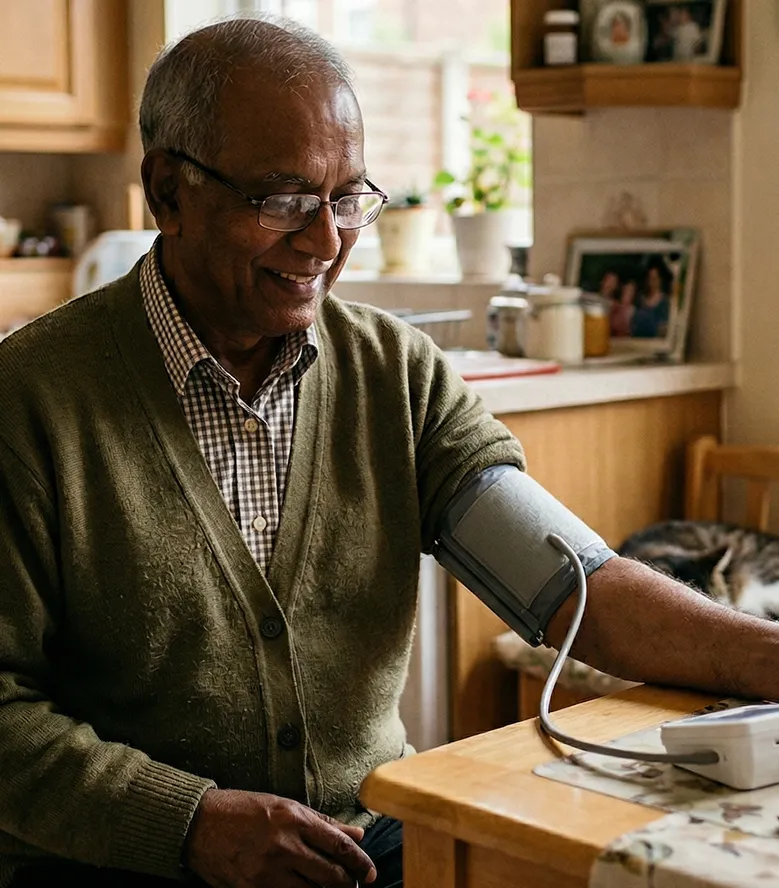
- Shipped cellular-connected RPM devices directly to patients' homes — no WiFi required, no smartphone needed, one-button operation. The patient-side engagement problem that kills most RPM programs was designed out.
- Assigned a dedicated, named care navigator to every enrolled patient. Monthly CCM touches, 48-hour post-discharge TCM outreach, daily RPM triage — all delivered by the same human, so the patient experiences one relationship, not four programs.
- Deployed HealthQuilt — CareAtlas's proprietary platform — as the coordination layer. AI-drafted documentation, care-gap surfacing, structured capture of every qualifying element for CCM / RPM / TCM billing. Month-end becomes a report, not a reconciliation.
- Served as provider of record through CareAtlas's affiliated professional corporation — so the partner health system referred eligible patients without hiring navigators, without buying devices, and without a capex ask. CareAtlas bills Medicare directly under the arrangement.
- Pushed structured clinical summaries back into the partner's EHR on cadence, so the referring physicians saw CareAtlas's work inside the workflow they already trusted — no separate login, no new IT project.
Impact Section
14.8%
Vs. 19%. CMS benchmark
A 23% relative reduction in 30-day readmissions across a 145-patient cohort, October 2025. The cohort composition — 89% age 65+, 38% COPD, 24% CHF — was intentionally disclosed so the benchmark comparison was honest. The population was chosen because it was hard, not easy.
73%
Of enrolled patients submit readings 8+ days per month
The number most RPM programs never see. Adherence is the mechanism — without it, there's no clinical signal to act on and no billable month. CareAtlas's activation-call-by-a-named-navigator model is the reason the number held at month two, month six, and beyond.
85%
About
The honesty metric. If the program felt like a call center to patients, they'd have left. About 85% of activated patients were still enrolled at six months. The relationship-based model — same named navigator, every month — is why.
4+
Touches per patient
Not notifications — calls, from a named navigator, covering medication, symptoms, SDOH barriers, care-plan updates. The monthly cadence is the operational choice most programs fail to sustain. CareAtlas sustains it by doing the work outside the partner's clinical staff queue — completely separate, completely accountable.
Recognition
HIMSS26 Emerge Experience Winner's Circle — Hospital Systems category.
One of the year's health-system innovation honors, specifically recognizing partnerships that deliver measurable clinical and operational impact in real-world settings. The recognition acknowledged the partnership's results — the outcome numbers above, in the population above.
HIMSS26
.webp)